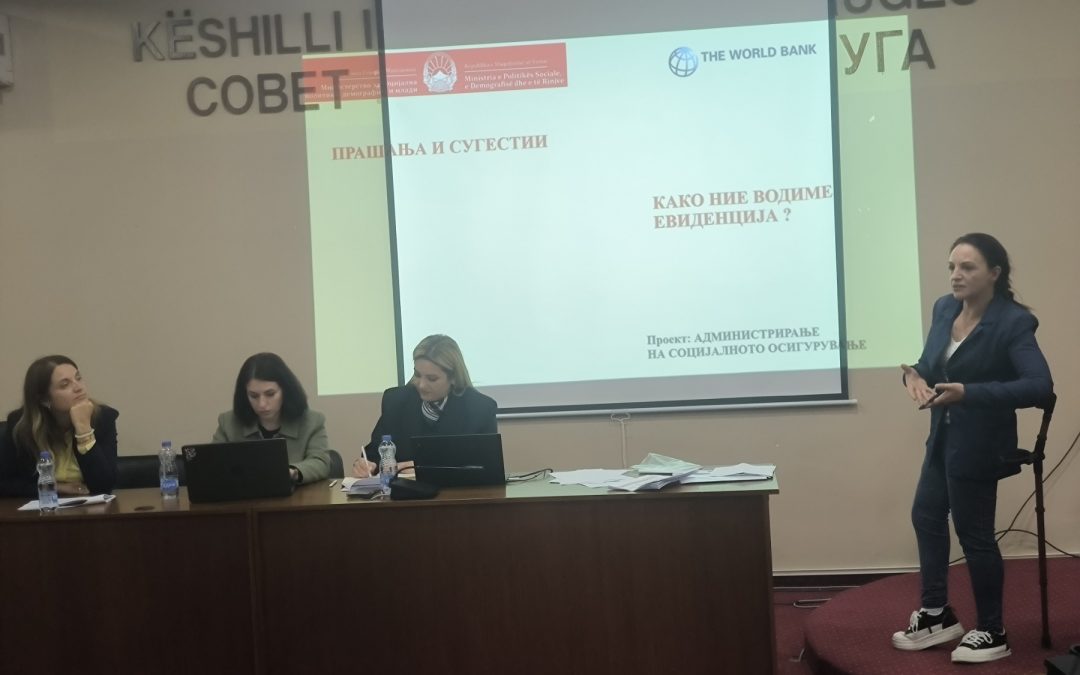
On 24 April 2026, an informative meeting dedicated to the reforms within the Social Insurance Administration Project (SIAP) was held at the premises of the Centre for Development of the South-West Planning Region in Struga. The event was organized by the Ministry of Social Policy, Demography and Youth in cooperation with the Centre for Development of the South-West Planning Region.
The meeting was attended by representatives of the Ministry of Social Policy, Demography and Youth, representatives of the SIAP Project Management Unit, the Mayor of Municipality of Makedonski Brod, local self-government representatives, and members of local social protection councils. A total of 19 participants attended the meeting, including 9 women and 10 men, among them 2 persons with disabilities.
During the meeting, the key reforms implemented under SIAP were presented, including:
- establishment of the Single Unified Registry System for mandatory social insurance (SURS),
- establishment of a Unified Disability Assessment System through the Central Disability Certification Coordination Unit (CDCCU),
- reform of the employment system for persons with disabilities,
- reform of hazardous occupations and early retirement policies.
The meeting was opened by Ms. Drita Asllani, State Adviser at the Ministry of Social Policy, Demography and Youth, who presented the reform processes and their importance for the modernization of the social protection system through digitalization, institutional integration, and simplification of administrative procedures.
Furthermore, Ms. Elena Kochoska presented the component related to the unified disability assessment system through the CDCCU, as well as the reforms related to the employment of persons with disabilities, with a focus on professional rehabilitation and improved inclusion in the labour market.
The presentation on the Single Unified Registry System (SURS) was initiated by Ms. Irena Karakashev and continued by Ms. Arlinda Balazhi, highlighting the system’s role in data exchange and integration, digitalization of processes, and improvement of administrative efficiency.
During the discussion, participants expressed interest in the implementation of the reforms at the local level, shared practical experiences, and raised questions related to the functioning of the new systems and their impact on existing social services. The need for improved coordination, additional information sharing, and strengthening of local capacities was emphasized.
The meeting contributed to a better understanding of the reforms and confirmed the importance of continuous communication and cooperation between central and local institutions for the successful implementation of the reform processes within SIAP.